You’ve undoubtedly kicked one foot out from under the blanket to cool off at night without even realizing it. However, this widespread sleeping practice isn’t merely an odd comfort measure. It may be one of the easiest and most efficient ways to facilitate your body’s quicker and easier transition into sleep, according to scientists.
What, therefore, makes the dangling foot trick so effective? As it turns out, the solution is found in the way your body automatically regulates its temperature before bed and in the special way your feet are made to aid in this process.
Sleep, feet, and heat
As evening approaches, your body naturally lowers your core temperature as part of the circadian rhythm to get ready for sleep. According to experts, this physiological cooling is necessary to start a deep, peaceful slumber.
The release of the sleep hormone melatonin coincides with the temperature decrease that begins approximately two hours prior to bedtime, according to the Sleep Foundation. “Body temperature continues to decrease while you sleep, dipping to a low point in the early morning and then gradually rising as the morning wears on.”
Your body pushes heated blood toward the surface, especially your hands and feet, and away from the center throughout this cooling process. These limbs function as natural heat vents when exposed to chilly air, releasing extra heat to hasten your body’s transition to sleep mode.
Ideal tools for releasing heat
Your hands and feet, in contrast to the majority of other body parts, are abundant in arteriovenous anastomoses, which are specialized blood arteries that facilitate rapid heat escape. Your soles are very effective at cooling you down because of these arteries, which avoid capillaries and send warm blood directly to the surface.
A passive, adjustable cooling system can be created by protruding just one foot from under the covers. It’s little, understated, yet remarkably powerful—like opening a window in a warm room.
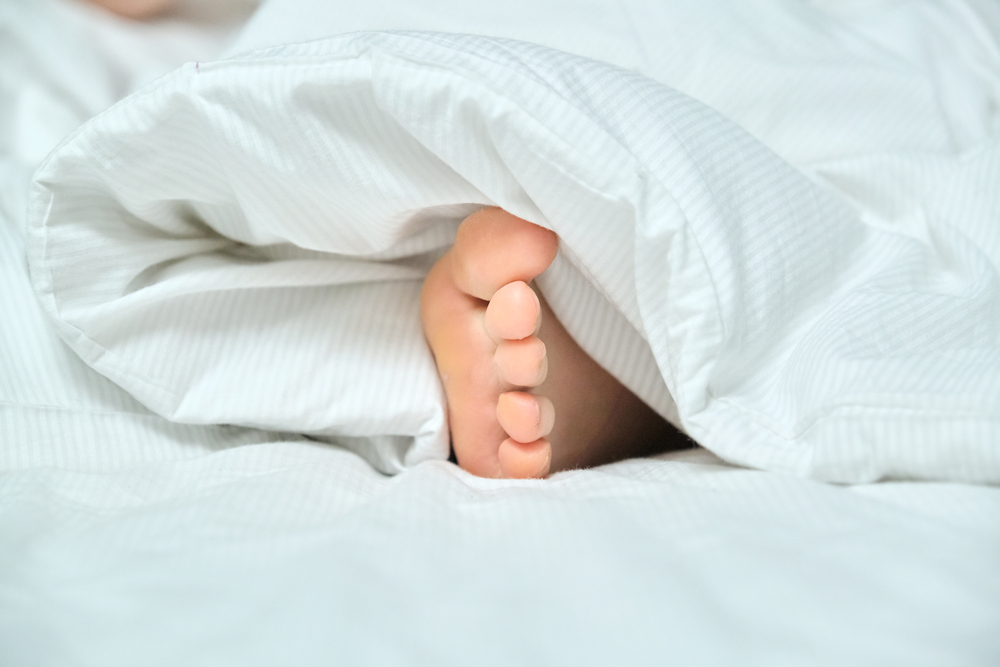
“I believe it’s probably an attempt to cool our bodies because we’ve become too hot to sleep,” Virginia Commonwealth University professor and sleep health researcher Natalie Dautovitch told New York Magazine. “You may be able to get a more restful sleep by sticking your foot or toe out.”
Go to sleep more quickly
The distal-to-proximal gradient (DPG), a measurement that contrasts the temperature of your hands and feet with that of your core, is another tool used by researchers. More heat is generated when the DPG is higher, and this is strongly associated with a quicker beginning of sleep.
According to a study published in the Journal of Physiology, individuals with warmer hands and feet—and hence a greater DPG—went to sleep much more quickly than those with colder extremities.
You may quickly increase this gradient by exposing one foot, which will help you fall asleep without having to take off all of your bedding or turn down the heat.
Additional strategies to encourage natural cooling
Allowing one foot to breathe is easy and efficient, but you can increase the effectiveness of your sleep routine by combining it with other cooling practices:
To increase skin temperature and cause cooling after drying off, take a warm bath one to two hours before bed.
The Sleep Foundation advises keeping your bedroom chilly, ideally between 65 and 68 degrees Fahrenheit, for the best sleep.
If you have cold feet, warm them up with socks or a foot bath before bed. If necessary, take off layers to adjust comfort.
For some people, dangling feet are ineffective.
The foot-out method is useful for many people, but it’s not universally applicable. Exposing your foot may be uncomfortable if you have Raynaud’s disease, poor circulation, or a tendency toward cold feet. In some situations, it could be more effective to gently warm the feet before bed than to chill them.
Additionally, heat conservation may be more advantageous than heat release for children, the elderly, and people sleeping in already chilly conditions. The secret is to adapt according to how your body feels, and keep in mind that the objective is comfort rather than perfection.
Try sticking one foot out the next time you’re writhing under the covers. By using your body’s natural thermoregulation system, this tiny action lets heat escape and softly encourages your brain to go to sleep.
Better sleep can sometimes truly begin at the very beginning!